









Many organizations are under the impression that if they simply configure their end-user profiles to be limited capabilities (LMTCPB(*YES)) and set their initial menu to *SIGNOFF, that their end-users will be confined to a menu, can’t run commands and, therefore, are restricted in what they can access. Surely, they can’t access application data! But what if they can? Penetration Testing for IBM i performs tests to determine what – if any – application data these limited users can access.
DXR Security’s Penetration Testing for IBM i can give you peace of mind and help you determine whether your limited users truly are limited. We do that by performing “gray box” pen testing. In other words, we use information about security-relevant system values as well as the authority settings of application libraries and database files together with user profiles that represent a cross-section of end-user roles as input to our tests. Then, we’ll attempt to gain access to and perform tasks on your IBM i. Penetration Testing for IBM i is a great add-on to network penetration tests which identify open ports and unsecure protocols. DXR Security takes penetration testing to the next level by attempting to run various tasks directly on the system with the intent of determining whether limited users truly are limited. Once testing is complete, we’ll provide an easy-to-read report describing the results and provide specific recommendations for hardening security, should any vulnerabilities be identified.
The greatest benefit from DXR Security’s Penetration Testing for IBM i is the proof of whether or not your IBM i security configuration is working as expected. Use this proof as peace of mind that your limited users truly are limited or to develop actions to further restrict them.
Contact DXR Security today to see how pen testing can give you proof your security is working. Or visit https://www.dxrsecurity.com/.

Carol Woodbury is IBM i Security SME and Senior Advisor to Kisco Systems, a firm focused on providing IBM i security solutions. Carol has over 30 years’ experience with IBM i security, starting her career as Security Team Leader and Chief Engineering Manager for iSeries Security at IBM in Rochester, MN. Since leaving IBM, she has co-founded two companies: SkyView Partners and DXR Security. Her practical experience and her intimate knowledge of the system combine for a unique viewpoint and experience level that cannot be matched.
Carol is known worldwide as an author and award-winning speaker on security technology, specializing in IBM i security topics. She has written seven books on IBM i security, including her two current books, IBM i Security Administration and Compliance, 3rd Edition and Mastering IBM i Security, A Modern, Step-by-Step Approach. Carol has been named an IBM Champion since 2018 and holds her CISSP and CRISC security certifications.
MC Press books written by Carol Woodbury available now on the MC Press Bookstore.
 |
||
 |
|
IBM i Security Administration and Compliance: Third Edition Don't miss the newest edition by the industry’s #1 IBM i security expert. List Price $71.95 Now On Sale
|
 |
|
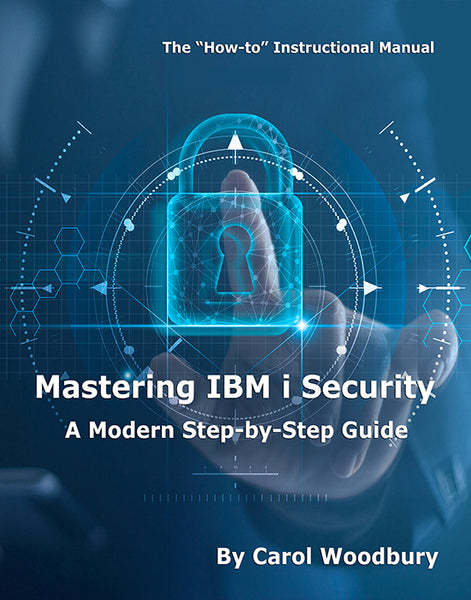
Mastering IBM i Security Get the must-have guide by the industry’s #1 security authority. List Price $49.95 Now On Sale
|

 Business users want new applications now. Market and regulatory pressures require faster application updates and delivery into production. Your IBM i developers may be approaching retirement, and you see no sure way to fill their positions with experienced developers. In addition, you may be caught between maintaining your existing applications and the uncertainty of moving to something new.
 IT managers hoping to find new IBM i talent are discovering that the pool of experienced RPG programmers and operators or administrators with intimate knowledge of the operating system and the applications that run on it is small. This begs the question: How will you manage the platform that supports such a big part of your business? This guide offers strategies and software suggestions to help you plan IT staffing and resources and smooth the transition after your AS/400 talent retires. Read on to learn:
LATEST COMMENTS
MC Press Online