









Embedded Structured Query Language (SQL) has been available to the RPG programmer for a long time.
Editor's Note: This article is excerpted from chapter 7 of Free-Format RPG IV: Third Edition, by Jim Martin.
This chapter is intended to show you the differences between fixed-format RPG IV with embedded SQL and embedded SQL within a free-format RPG IV program. My assumption is that you already know how to code SQL statements. Only the differences between fixed- and free-format embedded SQL will be presented.
Database and Embedded SQL
SQL allows a user a great deal of flexibility when working with a database. A user can affect a large number of records within a file with very little code. The strengths of a procedural language such as RPG IV are combined with the strengths of SQL when embedding SQL statements within a program.
Fixed-Format Method
RPG source programs that contain embedded SQL have a member type of
SQLRPGLE rather than RPGLE. This member type causes the SQL precompiler
to be invoked. The precompiler modifies the /Exec SQL statements (mostly into API calls) prior to invoking the regular RPG IV compiler. The general rules to follow in fixed-format RPG IV are as follows:
- An SQL statement must be preceded by the precompiler directive C/Exec SQL
- The SQL statement must be followed by another precompiler directive, C/End-SQL.
- The SQL statement can begin on the same line as the C/Exec SQL line, but most programmers code the SQL statement on a separate line.
- Access to host variables is accomplished by preceding the variable name with a colon (:).
- The SQL communications area is included in every program (in a data structure) in definition specifications.
- Each source line of the SQL statement between the C/Exec SQL line and the C/End-SQL line must contain C+ in positions 6 and 7.
- The SQL statement can be entered anywhere in positions 9–80. Position 8 must be left blank.
Listing 7-1 shows an example of an SQL statement in fixed-format RPG IV.
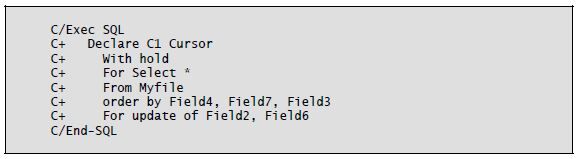
Listing 7-1: Sample embedded SQL statement in fixed-format RPG IV
A nice feature of fixed format is the ability to prompt (using F4) and fill in values on the prompt screen.
Free-Format Method
While free format introduces some differences from fixed-format SQL, some things stay the same:
- The source member type is still SQLRPGLE.
- The SQL communications area (data structure) is included in every program, as before, in definition specifications.
- Access to host variables is also the same, achieved by preceding the variable name with a colon (:).
The following points detail the changes to embedded SQL when you are coding within a free-format section of RPG IV code:
- No C is placed in position
- The SQL precompiler directive includes no preceding forward slash (/). The statement is just Exec SQL.
- No C+ is used on subsequent lines; continuation is automatic. If a character literal must be split between lines, include a “+” symbol at the end of the first line to indicate that the literal is continued on the next line.
- The SQL statement may be entered anywhere in positions 8–80, the same as any free-format statement.
- The embedded SQL statement is ended with a semicolon (;), the same as other free-format statements. This character replaces the End-SQL statement that fixed format uses.
- Prompting is not
Listing 7-2 shows an example of an embedded SQL statement coded in free-format RPG IV. It is the same statement that was used in Listing 7-1. The indenting in this example is done manually to aid the program reader. Multiple lines are used for the same reason, and to make it easier to make changes.
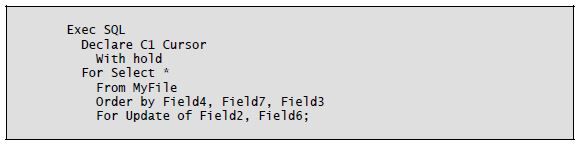
Listing 7-2: Sample embedded SQL statement in free-format RPG IV
More of Jim's Free-Format RPG IV is coming soon in an upcoming MC Press Publication. Can't wait? You can pick up Jim Martin's book, Free-Format RPG IV: Third Edition at the MC Press Bookstore Today!

Jim Martin holds a BS degree in mathematics and an MS in computer science. For 26 years, he was employed by IBM, where he wrote RPG applications for customers and worked in the programming laboratory as a programmer on portions of CPF and the OS/400 operating system. After leaving IBM, Jim took post-graduate work in computer science and performed RPG training. He is an IBM-certified RPG IV developer and author of multiple bestselling editions of Free-Format RPG IV, which, since the book's initial publication in 2005, have taught thousands of RPG IV programmers how to be successful with the free-format coding style.
MC Press books written by Jim Martin available now on the MC Press Bookstore.
 |
||
 |
|
Free-Format RPG IV: Third Edition Improve productivity, readability, and program maintenance with the free-format style of programming in RPG IV. List Price $59.95 Now On Sale
|
|
||
 |
|
Free-Format RPG IV: Second Edition >Make the transition from coding in fixed-format RPG to free format. List Price $59.95
Now On Sale
|
|
||
 |
|
Functions in Free-Format RPG IV Here’s the ultimate guide to writing RPG IV programs with functions in the free-format style. List Price $59.95
Now On Sale
|

 Business users want new applications now. Market and regulatory pressures require faster application updates and delivery into production. Your IBM i developers may be approaching retirement, and you see no sure way to fill their positions with experienced developers. In addition, you may be caught between maintaining your existing applications and the uncertainty of moving to something new.
 IT managers hoping to find new IBM i talent are discovering that the pool of experienced RPG programmers and operators or administrators with intimate knowledge of the operating system and the applications that run on it is small. This begs the question: How will you manage the platform that supports such a big part of your business? This guide offers strategies and software suggestions to help you plan IT staffing and resources and smooth the transition after your AS/400 talent retires. Read on to learn:
LATEST COMMENTS
MC Press Online