







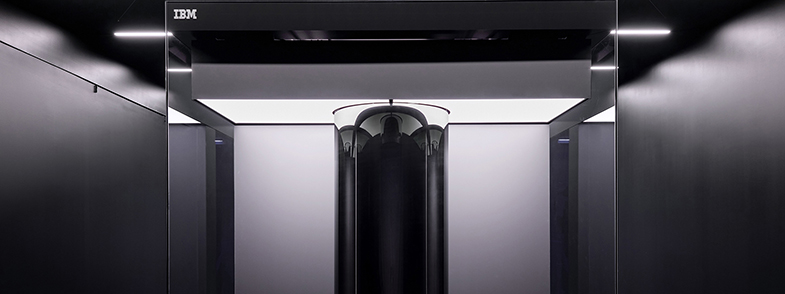
IBM Quantum System One also to be linked with Miyabi supercomputer at the Joint Center for Advanced High Performance Computing (JCAHPC)
The University of Tokyo (UTokyo) and IBM announced plans to deploy the latest 156-qubit IBM Heron* quantum processing unit (QPU), which will be operational in the IBM Quantum System One administered by UTokyo for the members of the Quantum Innovation Initiative (QII) Consortium. The IBM Heron QPU, which features a tunable-coupler architecture, delivers a significantly higher performance than the processor previously installed in 2023.
This is the second update of the IBM Quantum System One as part of the collaboration between UTokyo and IBM. It was first deployed with a 27-qubit IBM Falcon QPU, before being updated to a 127-qubit IBM Eagle QPU in 2023. It is now transitioning to the latest generation highly performant IBM Heron later this year. IBM has deployed four Heron-based systems worldwide and their performance shows significant improvement over the previous Eagle QPU, with a 3-4x improvement in two-qubit error rates; an order of magnitude improvement in device-wide performance benchmarked by errors across 100-qubit long layers; continued improvement in speed, with a 60 percent increase in CLOPS expected; and a system uptime of more than 95%. The latest IBM Heron processor has continued to demonstrate immense value in orchestrating utility-level workloads, to date, with multiple published studies leveraging these systems’ capability of achieving more than 5,000 gate operations.
IBM Quantum Heron
UTokyo is also planning to link the IBM Quantum System One to the Miyabi supercomputer later this year, enabling a quantum centric supercomputer. This will give the industry and academic users of the QII Consortium access to new computational capabilities and increasing performance in the domain areas such as chemistry, bioinformatics, high energy physics, materials science, finance and among many other disciplines.
Miyabi is a supercomputer operated jointly by the UTokyo and the University of Tsukuba through the Joint Center for Advanced High Performance Computing (JCAHPC). Miyabi is equipped with the most advanced CPUs and GPUs, and consists of two subsystems, Miyabi-C and Miyabi-G. Under current plans to be linked with UTokyo’s Heron-powered IBM Quantum System One later this year, the Miyabi supercomputer will allow QII users to explore computational problems such as making more precise measurement of quantum observables with neural network estimators.
“This update to an IBM Heron quantum processor, linked to our Miyabi supercomputer will allow us to further develop use cases that leverage quantum and AI capabilities, expanding the realm of computable problems in science and accelerating efforts to solve societal challenges.” said Hiroaki Aihara, Executive Vice President, UTokyo.
“By deploying our latest, best performing IBM Heron QPU in UTokyo’s IBM Quantum System One, as well as connecting the system to the Miyabi supercomputer, UTokyo will now join the leading global organizations that are defining the future of supercomputing. This quantum-centric supercomputer will provide QII Consortium members with new, more powerful computing power to solve problems that we anticipate will achieve quantum advantage,” said Jay Gambetta, Vice President, IBM Quantum.
Since UTokyo and IBM launched the Japan–IBM Quantum Partnership in 2019, UTokyo has continued to expand access to quantum computing in Japan. The aim of the Japan-IBM Quantum Partnership initiative, which has included the QII Consortium since 2020, is to accelerate the collaboration between industry, academia, and government to advance Japan’s leadership in quantum science, business, and education. The consortium has published more than 140 research papers based on experiments run on the IBM Quantum System One installed in Japan. UTokyo is also part of a consortium of universities in Japan, South Korea, and the United States to prepare more than 40,000 students for the quantum workforce over the next decade.
*The deployment of an IBM Heron in UTokyo’s IBM Quantum System One, and the IBM Quantum System One’s link to the Miyabi supercomputer are subject to issuance of appropriate export licenses and closing definitive agreements.
About the University of Tokyo
The University of Tokyo is Japan's leading university and one of the world's top research universities. The vast research output of some 6,000 researchers is published in the world's top journals across the arts and sciences. Our vibrant student body of around 15,000 undergraduate and 15,000 graduate students includes over 5,000 international students.
Find out more at www.u-tokyo.ac.jp/en/
 Business users want new applications now. Market and regulatory pressures require faster application updates and delivery into production. Your IBM i developers may be approaching retirement, and you see no sure way to fill their positions with experienced developers. In addition, you may be caught between maintaining your existing applications and the uncertainty of moving to something new.
 IT managers hoping to find new IBM i talent are discovering that the pool of experienced RPG programmers and operators or administrators with intimate knowledge of the operating system and the applications that run on it is small. This begs the question: How will you manage the platform that supports such a big part of your business? This guide offers strategies and software suggestions to help you plan IT staffing and resources and smooth the transition after your AS/400 talent retires. Read on to learn:
LATEST COMMENTS
MC Press Online