









We are living through one of the most significant transformations in the history of work. AI is reshaping roles, rewiring workflows, and redefining the nature of performance itself. Yet, a new global study from the IBM Institute for Business Value makes one thing clear: the technology is advancing faster than employees, managers, and organizations are prepared to keep up.
By Aparna Nair | Chief Talent, Leadership & Culture Officer, IBM
This gap explains one of the study’s most important insights: the biggest barrier to AI value isn't the technology itself. It's how organizations adapt their people, processes, and culture around it.
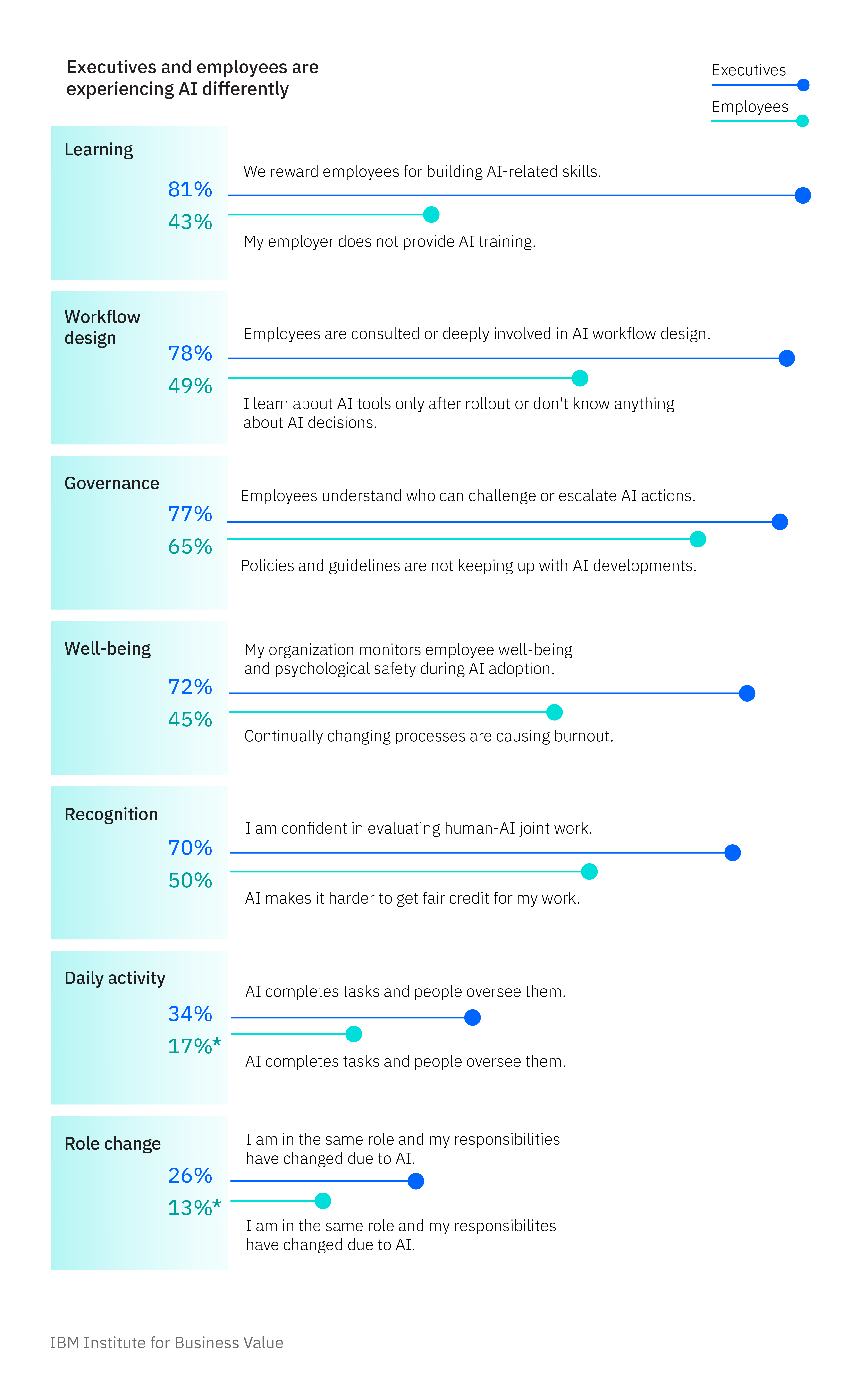
Nearly two-thirds of surveyed executives say AI is already reshaping roles and workflows. But what I see consistently is that many organizations have yet to redesign the management practices, performance systems, and workforce support structures needed to make those changes effective. The result? A growing and consequential disconnect between how leaders report AI progress and how employees experience it*.
Executives surveyed report AI-driven role change at twice the rate employees experience it in their own jobs. While 81% of executives say employees are rewarded for building AI skills, 43% of employees say their employer does not provide AI training. These aren't just numbers. They show a growing trust gap that could hinder the progress we’re trying to make.
Creating a culture that supports AI
Successful AI adoption depends on people feeling more confident speaking up, questioning results, and applying their judgment. Yet, 43% of executives say employees don't feel safe raising concerns about AI outputs, and more than half of employees say people fail to challenge AI when they should. When people feel safer agreeing than questioning, the issue isn’t the tool – it’s how organizations enable or discourage its use.
At IBM, we've long believed that curiosity and continuous learning isn't a nice-to-have, it's the foundation of how we perform. We embed skill-building into performance, promotions, and compensation because we know that people need to feel genuinely supported and rewarded to bring their best thinking to new ways of working. The study reinforces exactly that: among top-performing organizations, employees are far more likely to trust leadership guidance on AI transformation than at other organizations. When culture, incentives, and leadership are aligned, trust follows, and transformation is more likely to succeed.
Managers are being asked to lead differently
Managers are at the center of this transition. They're increasingly expected to coach judgment, oversee human-AI collaboration, and evaluate performance in ways that simply didn't exist a few years ago. The study, however, suggests many organizations lack the structure to support managers in this capacity. Ninety-three percent of executives say AI-enabled work has made performance significantly harder to evaluate, while only about a quarter of employees say their managers primarily focus on coaching and strategic judgment, even as that expectation is set to nearly double by 2028.
This is a pivotal moment for people leaders. The manager's role is evolving from directing tasks to developing stronger decision-making across teams. That requires investment in new skills, clearer expectations, and the tools to lead effectively in an AI-enabled workplace. At IBM, we believe this is one of the most important leadership challenges of our time, and one we must meet with the same intentionality we bring to any transformation.
The organizations getting it right
The study identifies a small but telling group of organizations that have achieved both advanced AI maturity and strong organizational change capabilities. What sets them apart? They've built clarity into the work itself – defining who is accountable, establishing clear norms for when AI should be trusted or challenged, and aligning performance systems to reflect how work has changed.
The results speak for themselves: organizations that take this approach are achieving up to 73% higher revenue growth and an 11% operating margin advantage over their peers.
What people leaders should do next
AI adoption is exposing gaps in how organizations make decisions, reinforce behaviors, and scale judgment. To build trust and realize value, here is where to start:
- Treat major AI-enabled workflow changes as people adoption challenges, not just technology deployments. Define the skills, behaviors, and confidence employees need before scaling news ways of working.
- Update performance systems to reward learning, responsible challenge, and sound judgment. Incentives should reinforce how work gets done, not just how quickly it gets done.
- Create opportunities for employees to practice decision-making through simulations, sandbox environments, and real-world examples that demonstrate when to trust AI, when to challenge it, and when to escalate concerns.
The organizations that will lead in this era won't just be the ones with the best AI. They'll be the ones that invest equally in the human systems around it. That's the work in front of all of us.
To access the full study, visit: https://ibm.biz/ai-human-op-model
*Where AI breaks – or breaks through study
 Business users want new applications now. Market and regulatory pressures require faster application updates and delivery into production. Your IBM i developers may be approaching retirement, and you see no sure way to fill their positions with experienced developers. In addition, you may be caught between maintaining your existing applications and the uncertainty of moving to something new.
 IT managers hoping to find new IBM i talent are discovering that the pool of experienced RPG programmers and operators or administrators with intimate knowledge of the operating system and the applications that run on it is small. This begs the question: How will you manage the platform that supports such a big part of your business? This guide offers strategies and software suggestions to help you plan IT staffing and resources and smooth the transition after your AS/400 talent retires. Read on to learn:
LATEST COMMENTS
MC Press Online