








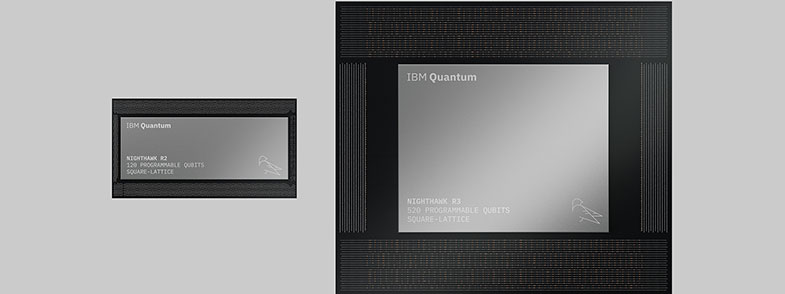
New Nighthawk r3 processor will be built to execute 10,000 quantum operations, enabling larger and more complex computations as IBM advances its roadmap toward fault tolerance
Clients and partners including E.ON, Algorithmiq, and Q-CTRL have run more than 34 billion circuits on Nighthawk r2, reporting speedups of up to 19x beyond previous IBM quantum processors
Enhanced IBM Quantum Platform unites quantum with classical computing in one environment
By IBM Corporation
IBM today announced IBM Quantum Nighthawk r3, its next-generation processor, will be built to accurately execute 10,000 quantum operations across 520 qubits to tackle larger, more complex problems while maintaining the speed and quality demonstrated by the current generation Nighthawk available today.
In 2027, IBM plans to link two Nighthawk r3 processors into a single system with more than 1,000 qubits.
To be at the frontier of quantum computing, industry-relevant applications demand both computational quality and speed. Speed matters because a quantum computer delivers its answer in samples: each run of a quantum circuit returns one result. Applications increasingly require circuits executing thousands of quantum operations on approximately 100 qubits or more, generating millions to billions of samples. Scale and quality enable increasingly complex computations, but speed determines whether these demanding workloads can be completed in practical timeframes and at a reasonable cost.
“Useful quantum computing hinges on whether results can be delivered with accuracy and speed, both are fundamental,” said Jay Gambetta, Director of IBM Research and IBM Fellow. “Nighthawk is already showing us what that looks like today. As we scale this architecture to larger and more powerful quantum computers, the capabilities of quantum computation will reach new levels as we integrate more closely with classical resources and march ahead to fault tolerance.”
Nighthawk r2: Delivering Speed for Real-World Workloads
Introduced in September, IBM Quantum Nighthawk r2 delivers up to 100,000 samples per second while supporting accurate computations with more than 7,500 quantum operations on 120 qubits. Its high-speed qubit reset technology dramatically reduces the time between circuit executions, enabling applications to collect the millions or billions of samples needed for complex computations far more efficiently.
Clients and partners including E.ON, Algorithmiq, and Q-CTRL have executed 34 billion circuits on Nighthawk r2 to date, reporting performance improvements of up to 19x while maintaining the quality needed for scientific computation.
The results are already demonstrating value across industries. E.ON reported a 15x speedup on Nighthawk r2 in quantum machine learning for energy grid optimization. IBM used Nighthawk r2 for a 12x speedup of an experiment ran earlier this year with Oak Ridge National Laboratory, which simulated real magnetic materials and produced results consistent with neutron scattering experiments. Both of these speedups were achieved over previous work on IBM Quantum Heron. Quantum Elements and ParityQC are also among the partners reporting significant performance improvements on their own Nighthawk r2 workloads.
The quantum advantage experiments IBM and its partners published in July were first run on IBM Quantum Heron, with circuits and results openly available for independent testing through the community-led Quantum Advantage Tracker. An experiment with Algorithmiq to simulate a heterogeneous quantum material has now been extended to Nighthawk r2, leveraging its speed and connectivity to execute circuits 8 times faster than the original experiment on Heron. At the same time, the new circuits are significantly more challenging for classical computers to simulate, requiring an estimated 240 times more memory to achieve comparable accuracy when using leading classical tensor-network methods.
Nighthawk r3: Scaling to More Than 1,000 Qubits
Building on the performance demonstrated by Nighthawk r2, Nighthawk r3 will extend the same high-speed architecture to larger quantum computers. The new processor is designed to support 10,000 quantum operations on 520 programmable qubits, with 2,034 total physical qubits. It retains r2's square-lattice connectivity and fast operations while introducing 10 chip-to-chip interconnects, called l-couplers, designed to connect processors into larger systems.
IBM has already demonstrated two critical technologies that enable this modular approach. This year, IBM connected Nighthawk r1 processors using four l-couplers, achieving 99.3 percent quantum state transfer fidelity and progressing toward its 99.9 percent target. IBM also connected two cryogenic modules into a single system for the first time, reaching operating temperature in under five days and cooling below 15 millikelvin.
Together, these advances demonstrate critical progress in modularity and provide confidence in IBM's ability to scale Nighthawk to larger quantum computers. In 2027, IBM plans to connect two Nighthawk r3 processors into a single 1,040-qubit system, extending its high-performance architecture to larger and more complex computations.
Quantum Meets Classical on the IBM Quantum Platform
Advancing quantum computers requires continued progress in how they work alongside classical compute to handle errors. Industry-relevant workloads will demand layers of quantum error correction and error mitigation techniques alongside noise learning and post-processing. As quantum workloads scale, they will call for more classical resources, and the challenge now is how to best scale this integration.
To unite these paradigms, IBM Quantum Platform is bringing high-performance (HPC) classical and quantum computing together into a single managed environment. Users can now integrate quantum workflows directly with a range of classical compute – whether from their laptop or a powerful supercomputer – or with the HPC and classical resources that are newly available on the platform.
Users are seeing promising results from these integrations. For example, using the new environment, IBM and RIKEN* scientists executed their original sample-based quantum diagonalization (SQD) workflow roughly 5 times faster while performing 100 times more computations than in the original study. Cleveland Clinic and RIKEN also leveraged the platform to automatically process 608 million samples for modeling biologically relevant structures, 33 times faster than without workflow automation.
Enhanced capabilities will also fuel breakthroughs in quantum error correction. IBM Quantum Platform offers pulse-level capabilities to give researchers precise control over how they can detect, understand, and better correct errors within quantum and classical architectures. This helps them better time operations, reset qubits faster, and extract more information from quantum measurements – giving researchers the visibility to improve error correction at its most fundamental levels.
IBM recently launched a new co-design platform for quantum error correction with Oak Ridge National Laboratory and AMD that physically co-locates Nighthawk with ORNL’s Umbra High-Performance Computing (HPC) system, powered by AMD Instinct™ MI355X GPUs and 5th Gen AMD EPYC™ CPUs.
 Business users want new applications now. Market and regulatory pressures require faster application updates and delivery into production. Your IBM i developers may be approaching retirement, and you see no sure way to fill their positions with experienced developers. In addition, you may be caught between maintaining your existing applications and the uncertainty of moving to something new.
 IT managers hoping to find new IBM i talent are discovering that the pool of experienced RPG programmers and operators or administrators with intimate knowledge of the operating system and the applications that run on it is small. This begs the question: How will you manage the platform that supports such a big part of your business? This guide offers strategies and software suggestions to help you plan IT staffing and resources and smooth the transition after your AS/400 talent retires. Read on to learn:
LATEST COMMENTS
MC Press Online