








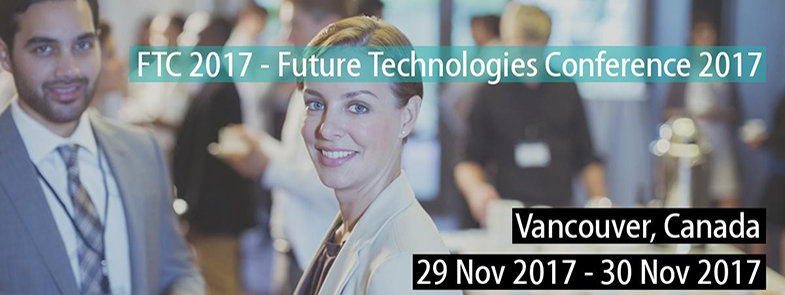
More than 200 leading researchers from over 50 countries will gather at the Future Technologies Conference (FTC) 2017 in Vancouver next month. FTC 2017 is a two-day conference which will take place on 29-30 November 2017 in Vancouver, BC, Canada.
The aim of the conference is to provide a platform for the researchers, academicians, engineers, as well as the industry professionals from around the world to present their development activities and research results in the areas of Computing, Electronics, AI, Robotics, Security & Communications.
The conference showcases deliberations from reputed researchers and technology leaders including a a keynote by John Martinis, Research Scientist at Google heading the hardware effort to build a useful quantum computer. In his talk, John will talk explain how a 7 by 7 array of superconducting qubits can compute over a huge state space of 2^49 = 560 trillion states, which can only be checked using the world's largest classical supercomputers. He will present progress towards the "quantum supremacy" experiment.
Peter Mueller from IBM Zurich Research Laboratory will start with a brief look at the quantum technology roadmap in areas such as sensors, communications and computing.
"We will depict device building blocks and present the architecture of one of IBM's quantum-processing devices that is publicly accessible today," said Peter Mueller.
James Hendler, Professor of Computer, Web and Cognitive Sciences, Rensselaer Polytechnic Institute (RPI) is also one of the keynote speakers. James is one of the originators of the Semantic Web. In 2013, he was appointed as the Open Data Advisor to New York State and in 2015 appointed a member of the US Homeland Security Science and Technology Advisory Committee. In 2016, Hendler became a member of the National Academies Board on Research Data and Information. In his talk, James will talk about The Collision of Artificial Intelligence, Social Networking, and Humanity.
Other speakers include Ann Cavoukian - former Information and Privacy Commissioner for the Canadian province of Ontario, Mohammad S. Obaidat – Professor at Fordham University, United States and Kevin Leyton-Brown Professor of Computer Science at the University of British Columbia.
In two days, the conference will host a total of six keynotes, five project demonstrations and 190 paper presentations organized into 19 sessions. The program also offers networking breaks which will give attendees the chance to mingle with other researchers.
The key intention of FTC 2017 is to provide international linkage for the future collaborations in technology research.
For more information and a complete agenda, visit website: http://saiconference.com/FTC2017/Agenda
 Business users want new applications now. Market and regulatory pressures require faster application updates and delivery into production. Your IBM i developers may be approaching retirement, and you see no sure way to fill their positions with experienced developers. In addition, you may be caught between maintaining your existing applications and the uncertainty of moving to something new.
 IT managers hoping to find new IBM i talent are discovering that the pool of experienced RPG programmers and operators or administrators with intimate knowledge of the operating system and the applications that run on it is small. This begs the question: How will you manage the platform that supports such a big part of your business? This guide offers strategies and software suggestions to help you plan IT staffing and resources and smooth the transition after your AS/400 talent retires. Read on to learn:
LATEST COMMENTS
MC Press Online