









Artificial intelligence is changing how software developers code and making both individual developers and their teams more productive. Generative AI in particular can boost productivity for software development teams.
By Rina Diane Caballar, Staff Writer, IBM Think & Cole Stryker, Staff Editor, AI Models, IBM Think
In an internal IBM test, for instance, participating teams using IBM® watsonx Code Assistant™ reported average time savings of 59% on code documentation, 56% on code explanation and 38% on both code generation and test case generation.1
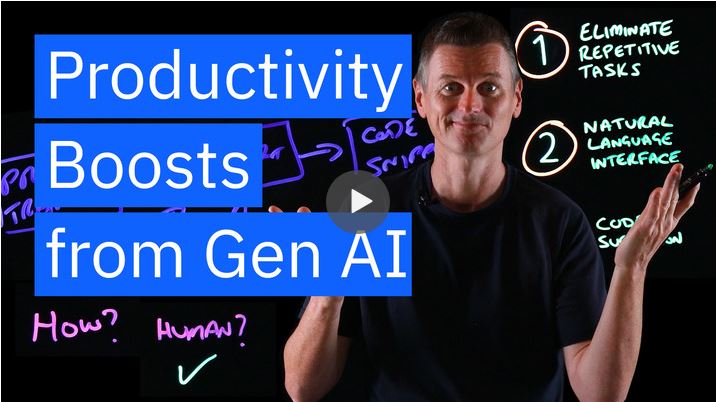
10 Developer Productivity Boosts from Generative AI (7:40 min)
However, software engineering productivity encompasses more than speed and efficiency. It also includes effectiveness, code quality and the developer experience. In some of these areas, AI can hinder more than help.
A study by nonprofit research organization METR found that AI tools might actually slow developers down in some cases. Those surveyed reported a few factors that might explain the reduction in speed, including AI tools performing worse in large and complex development environments and the tools’ lack of vital tacit context or knowledge.
Stack Overflow’s 2025 Developer Survey uncovered similar results. Respondents cited dealing with solutions that are “almost right but not quite” as their top frustration when it comes to AI tools, followed by the time-consuming process of debugging AI-generated lines of code. Surveyed developers also said they would still turn to another person for help when they don’t trust AI’s answers, have ethical or security concerns about code, want to learn best practices or when they’re stuck and can’t explain the problem.
This makes the human touch even more valuable to cultivate high-performing and productive developers. AI is becoming a must-have tool for software development, but it’s not a magic wand. Software development still requires input from humans to be effective. Here are six ways to enhance software developer productivity—with and beyond AI.
Automate the smart way
Some parts of the software development process can benefit from AI-assisted automation. DevOps is a prime example, automating an agile development cycle through continuous integration and continuous delivery (CI/CD).
Taking a page from the DevOps book, software engineering teams can automate repetitive or routine tasks to accelerate and streamline their workflows and redirect their efforts toward more productive initiatives, such as optimizing code or crafting new features. Infrastructure as Code (IaC) tools, for example, can automate setup and configuration for swift onboarding of new developers and for consistency among development, testing and production environments.
Other automation tools include linters and AI code review systems that analyze code for stylistic issues and programming errors, AI-powered security platforms for pinpointing vulnerabilities, and AI-driven code testing applications to verify functionality, quality and performance.
Design first, experiment later
When given a task, developers tend to jump right into programming. But laying out the design before translating it into code can save you time in the long run from having to debug or refactor subpar solutions. Even a rough flowchart, outline or schema can help you think through and devise the most optimal implementation.
Team leads must also set clear goals when assigning tasks to individual developers so they can budget their time and effort accordingly to achieve the expected outcomes. Additionally, providing software engineers with the autonomy to approach a problem their way imbues them with a sense of ownership and purpose, as they can contribute to the enhancement and evolution of the software they’re building. Such freedom to explore can even empower developers to move from optimization to innovation.
Foster the flow
Many artists produce their best work when they’re “in the zone”—a state of intense focus promoting peak performance. Since coding can also be considered an art form, unleashing a software engineer’s creativity entails giving them the time and space to reach a “flow state” and stay “in the flow.”
For developers, this means finding your most productive hours and allocating them as dedicated coding time. Try to minimize distractions during this period to maintain your concentration, such as pausing email and messaging notifications. Make sure to also build breaks in between to replenish your energy.
For software engineering leaders, this means respecting the boundaries each team member has set regarding their flow state. You can even block off time on their calendars for heads-down programming hours, shared deep work or short coding sprints.
Lessen the cognitive load
A lot of elements can disrupt a developer’s day, including unnecessary meetings, high-severity issues and urgent fixes. To cope, developers often resort to context switching and multitasking. Such frequent fragmentation can drain developers’ mental batteries and lead to burnout.
Team leads can assist with managing priorities and work in progress. Consider creating a weekly or biweekly roster of team members allotted to investigating and fixing high-severity issues. Include only essential members in meetings and define targeted agendas from the start.
Put together templates of structured solutions to challenging problems or common tasks so team members can reuse them rather than reinvent the wheel. Outline guides for coding standards and other best practices to help developers quickly figure out a suitable approach and avoid decision fatigue. Keep code documentation updated to cut back on time spent navigating the codebase. In many of these scenarios, AI can help, such as AI agents that keep documentation in sync with the current state of the repository or AI assistants that automatically apply the necessary coding styles and standards.
By reducing the cognitive load, developers gain back more brain power for programming and problem-solving.
Make room for growth
A software engineering work environment that promotes learning and encourages growth not only advances a developer’s skills but can also lift their motivation. According to PwC’s 2025 Global Workforce Hopes and Fears Survey, “workers who feel supported to upskill are 73% more motivated than those who report the least support.”2 Motivated employees are potentially more engaged and productive, which can in turn strengthen their job satisfaction and retention.
Typical opportunities for upskilling include enrolling in online courses and attending relevant conferences and workshops. Other methodologies for continuous improvement involve code reviews, mentoring and pair programming. These hands-on experiences allow members to share shortcuts, strategies and insights, contributing to a culture that values collaboration, support and teamwork.
Sharpen the tools of the trade
Coding skills and domain expertise are essential, but developers also need to channel those skills and expertise through high-quality tools. This includes integrated development environments (IDEs), programming languages and frameworks, project management software and version control systems, to name a few.
Make sure these tools blend in seamlessly with development workflows and software delivery processes to help increase the pace of building software and lessen development friction. Opt for modern technologies that have been tried and tested to avoid the technical debt associated with legacy systems and monolithic architectures.
In terms of frameworks and languages, pick those that not only align with business outcomes and project requirements but also fit your team’s capabilities. Robust documentation can aid in resolving issues rapidly, while an active community can offer support.
A note on productivity measurement
The adage that you can’t improve what you don’t measure also applies to developer productivity. Tech companies and research organizations have introduced different metrics, with DORA and SPACE standing out as popular benchmarks for measuring developer productivity.
As Google Cloud’s long-running research program, DORA aims to “understand the capabilities that drive software delivery and operations performance.” Here are its four key metrics:
- Change lead time (also known as cycle time) measures how long it takes for a code change or commit to reach production.
- Deployment frequency measures how often a team ships changes to production.
- Change fail percentage measures the percentage of deployments that lead to failures in production.
- Failed deployment recovery time measures how long it takes to recover from deployment failures.
DORA metrics represent quantitative measures that can indicate bottlenecks in the stability and throughput of software changes.
Meanwhile, researchers at GitHub and Microsoft created the SPACE framework composed of these productivity metrics:
- Satisfaction and well-being
- Performance
- Activity
- Communication and collaboration
- Efficiency and flow
SPACE metrics can be harder to measure since they’re more qualitative and subjective. Real-time surveys can help, capturing data during certain points in time.
Combining quantitative and qualitative measurements offer a more balanced view of both individual performance and team productivity. Avoid fixating on a single metric and choose those that matter most to your team so they can focus on the right ones.
Most of all, remember to treat metrics not as goals but as guides. Otherwise, developers work more on meeting them than delivering value, blocking productivity instead of benefiting it. The results of these measurements signal what needs to be improved and launches you on your journey toward a more productive software engineering team.
 Business users want new applications now. Market and regulatory pressures require faster application updates and delivery into production. Your IBM i developers may be approaching retirement, and you see no sure way to fill their positions with experienced developers. In addition, you may be caught between maintaining your existing applications and the uncertainty of moving to something new.
 IT managers hoping to find new IBM i talent are discovering that the pool of experienced RPG programmers and operators or administrators with intimate knowledge of the operating system and the applications that run on it is small. This begs the question: How will you manage the platform that supports such a big part of your business? This guide offers strategies and software suggestions to help you plan IT staffing and resources and smooth the transition after your AS/400 talent retires. Read on to learn:
LATEST COMMENTS
MC Press Online