








With two new research papers and an updated quantum roadmap, IBM® lays out a clear, rigorous, comprehensive framework for realizing a large-scale, fault-tolerant quantum computer by 2029.
By Ryan Mandelbaum, Jay Gambetta, Jerry Chow, Tushar Mittal, Theodore J. Yoder, Andrew Cross, Matthias Steffen, IBM Corporation
IBM has the most viable path to realize fault-tolerant quantum computing. By 2029, we will deliver IBM Quantum Starling — a large-scale, fault-tolerant quantum computer capable of running quantum circuits comprising 100 million quantum gates on 200 logical qubits. We are building this system at our historic facility in Poughkeepsie, New York.
Watch our new video, 'Realizing large-scale, fault-tolerant quantum computing,' on YouTube.
In a new paper, now available on the arXiv1, we detail a rigorous end-to-end framework for a fault-tolerant quantum computer that is modular and based on the bivariate bicycle codes we introduced with our landmark 2024 publication in Nature2. Additionally, we’re releasing a second paper3 that details the first-ever accurate, fast, compact, and flexible error correction decoder — one that is amenable to efficient implementation on FPGAs or ASICs for real-time decoding. We’ve updated our roadmap to match, with new processors and capabilities that will pave the way to quantum advantage, Starling, and fault tolerance.
Watch the 2025 IBM Quantum Roadmap update on YouTube.
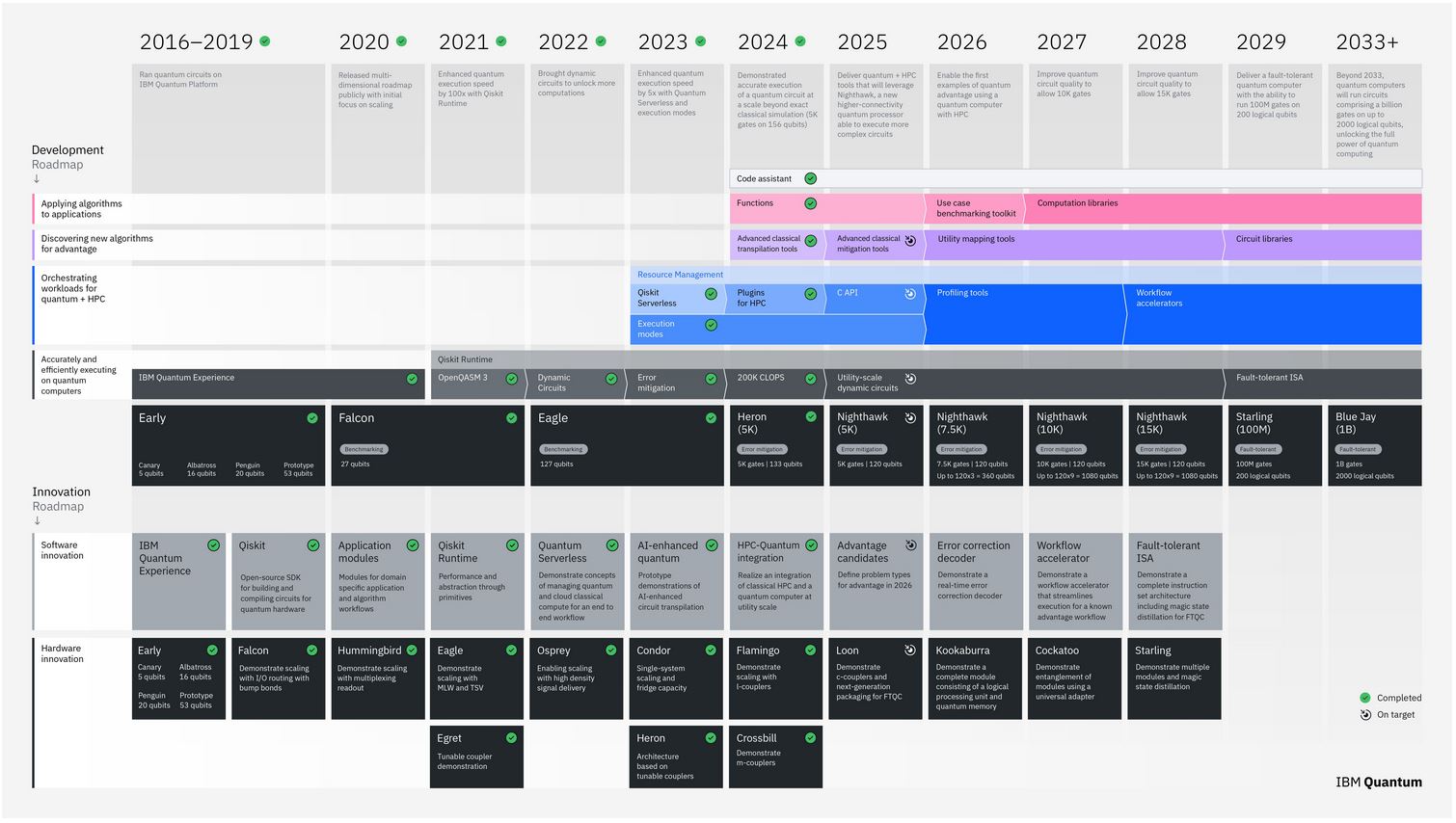
Since 2020, IBM has worked transparently along its quantum roadmap, laying out the steps required to realize useful quantum computing. Recent revisions to that roadmap project a path to 2033 and beyond, and so far, we have successfully delivered on each of our milestones. Based on that past success, we feel confident in our continued progress.
In fact, from what we have seen, IBM is the only quantum computing organization in the world that will be capable of running quantum programs at the scale of hundreds of logical qubits and millions of quantum gates by the end of the decade.
What makes us so confident? Let us show you.
Building a fault-tolerant quantum computer
Today, IBM is a leader in quantum computing. Our quantum computers are the only ones capable of delivering accurate results for quantum circuits with 5,000+ two-qubit gates. Based on research with partners such as RIKEN, Boeing, Cleveland Clinic, and Oak Ridge National Laboratory, we feel confident that our users will deliver quantum advantage — solving problems cheaper, faster, or more efficiently than classical alone — by the end of 2026, with quantum serving as an accelerator for classical HPC.
However, current devices and error-mitigating techniques limit us to small circuits. Unlocking the full promise of quantum computing will require a device capable of running larger, deeper circuits with hundreds of millions of gates operating on hundreds of qubits, at least. More than that, it will require a device capable of correcting errors and preventing them from spreading throughout the system. In other words, it will require a fault-tolerant quantum computer.
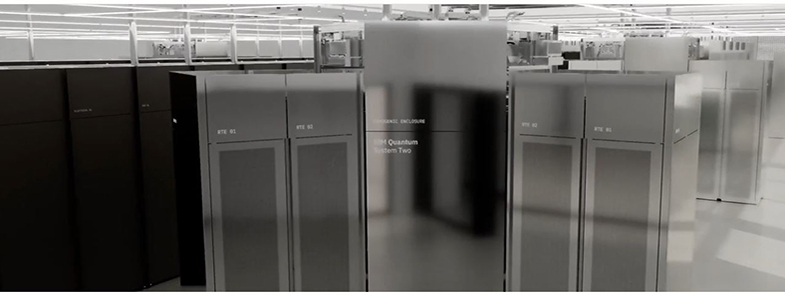
Watch 'Building the world’s first fault-tolerant quantum computer in Poughkeepsie, New York' on YouTube to preview our plans for the IBM Quantum Data Center in Poughkeepsie, NY.
In our new paper1, we detail six essential criteria for realizing a scalable architecture for reliable, large-scale quantum computing, and we show how our “bicycle architecture” meets these criteria. They are as follows:
- Fault-tolerant. Logical errors are suppressed enough for meaningful algorithms to succeed.
- Addressable. Individual logical qubits can be prepared or measured throughout the computation.
- Universal. A universal set of quantum instructions can be applied to the logical qubits.
- Adaptive. Measurements are real-time decoded and can alter subsequent quantum instructions.
- Modular. The hardware is distributed across a set of replaceable modules connected quantumly.
- Efficient. Meaningful algorithms can be executed with reasonable physical resources.
Below, we’ll lay out our architecture in more detail and explain how it meets these criteria. But before we do that, let’s briefly review how we detect and correct errors that arise in quantum computers.
Correcting errorsThe information of a logical qubit is encoded across many physical qubits to make it more resilient against errors.
Quantum error correction is the name for a family of techniques where we encode quantum information into physical qubits to protect them against errors. We do something similar in conventional computing. If we have three physical transistors and want to encode one binary digit's worth of information into them, then we could represent 0 as 000, and we could represent 1 as 111. We can define correction as majority voting — so even if one transistor errors, the encoded data isn’t corrupted. Let’s call 000 and 111 our three physical bits, and call the 0 and 1 they represent our logical bits.
Our goal is to do something similar in quantum computing — construct logical quantum bits, or qubits, from physical qubits. A physical qubit is a unit of well-isolated quantum computing hardware capable of being programmed and coupled to more than one other qubit in a controllable manner. A logical qubit is a qubit’s worth of encoded information that can be made from one or more physical qubits, depending on the quantum error correction code.
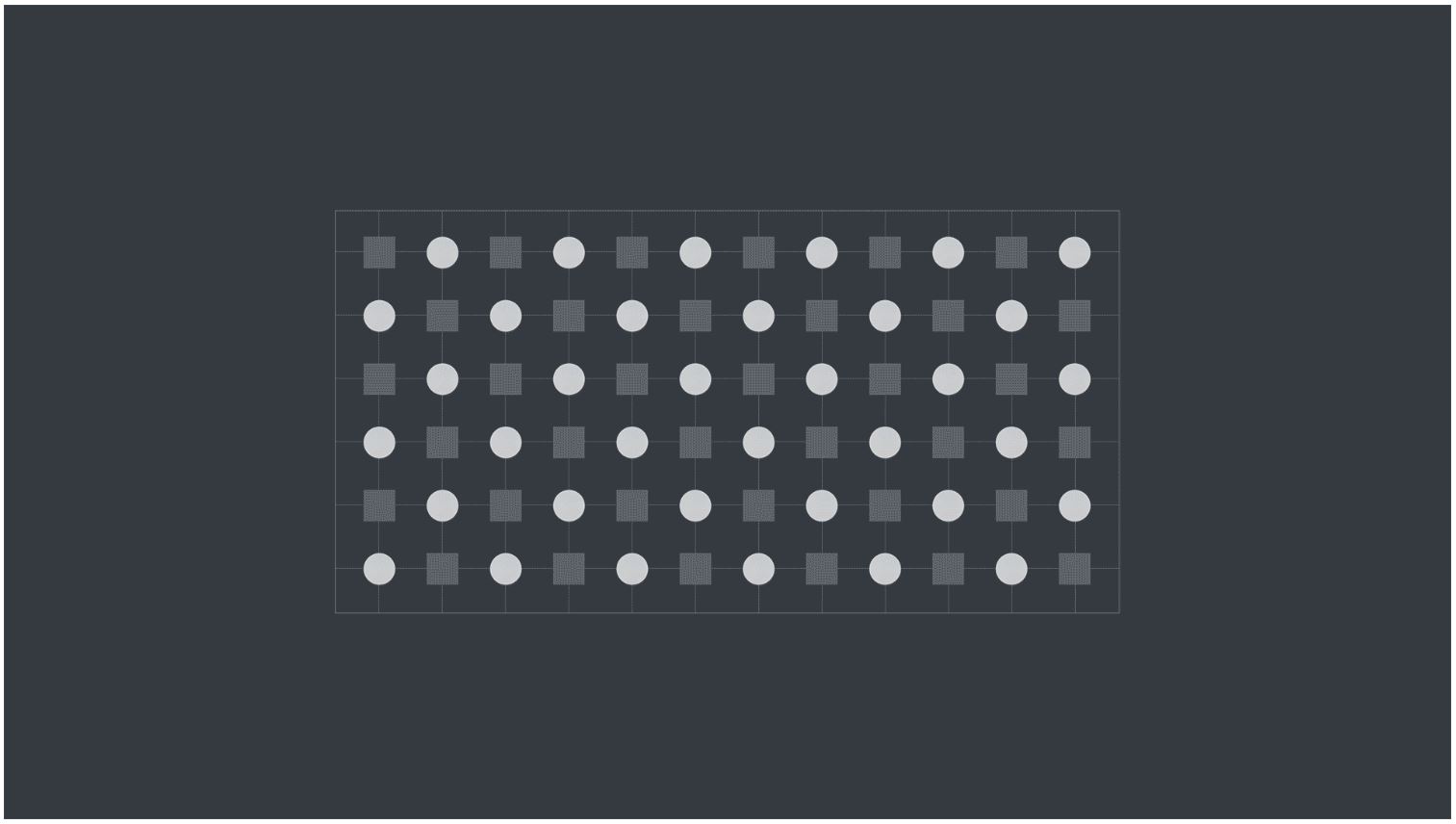
The information of a logical qubit is encoded across many physical qubits to make it more resilient against errors.
We denote a quantum code’s parameters by [[n, k, d]] where n is the number of physical data qubits required, k is the resulting number of logical qubits, and d is the distance of the code — how many errors it takes to silently corrupt the data encoded on the logical qubit (i.e., how many errors it takes to change an error-free encoded state to another encoded state that appears completely error-free). In a classical analog, you’d say the above code (0 = 000, 1 = 111) is a [3, 1, 3] code (note the single bracket for a classical code). An error correction code can correct up to (d-1)/2 errors and detect up to d-1 errors.
Just like classical computing, we can represent 0 and 1 as specific quantum states that incorporate multiple qubits. You might encode |00⟩ as |0000⟩+|1111⟩, |01⟩ as |1100⟩+|0011⟩, |10⟩ as |1010⟩+|0101⟩ and |11⟩ as |1001⟩+|0110⟩, for example. Then, we can monitor these qubits by regularly running error syndrome extraction circuits, which detect evidence of errors — for example, measuring an output with an odd number of 1s in the case described above would be an obvious error. Together, these make up what we call the quantum memory.
But you need more than a memory to compute. Quantum computing requires a universal gate set, or a set of logic gates to which every quantum computation can be reduced. Our universal gate set begins with a group of familiar gates called Clifford gates, which must run on the encoded information quickly and with limited overhead. It also requires at least one non-Clifford gate, such as the T gate, which is harder to realize. We apply T gates by creating special states called “magic states” on helper qubits, then we entangle these qubits into our circuits with Clifford gates.
We also need to be able to read out the logical qubits — for this, we use a tool called the decoder. This is classical hardware capable of reading the error syndromes, updating our beliefs about errors in real time, and outputting the corrected information. Finally, this whole system must be modular — it must scale to sizes large enough to run meaningful computations.
An architecture for realizing fault-tolerant quantum computing
Our new paper1 presents an architecture based on years of prior work, which meets these requirements for fault-tolerant quantum computing in a scalable system.
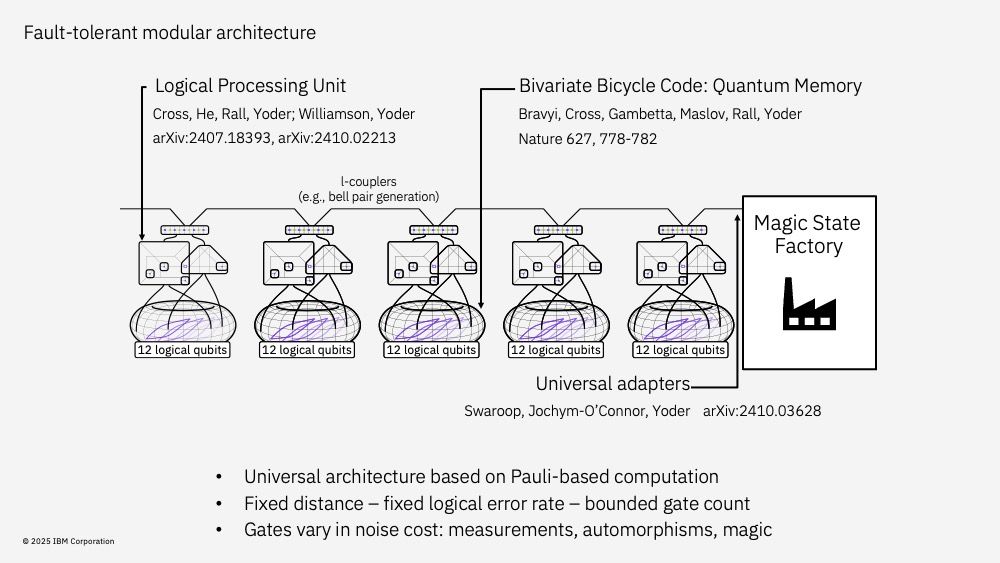
Our fault-tolerant modular architecture is based on the bivariate bicycle code developed by IBM.
Let’s walk through each step of that architecture. In 2024, we introduced a fault-tolerant quantum memory2 based on quantum low-density parity check (qLDPC) codes called bivariate bicycle (BB) codes. The [[144,12,12]] gross code encodes 12 logical qubits into 144 data qubits—a gross—along with another 144 syndrome check qubits, for a total of 288 physical qubits. This code corrects errors just as well as the surface code does, but requires 10x fewer qubits to do so.
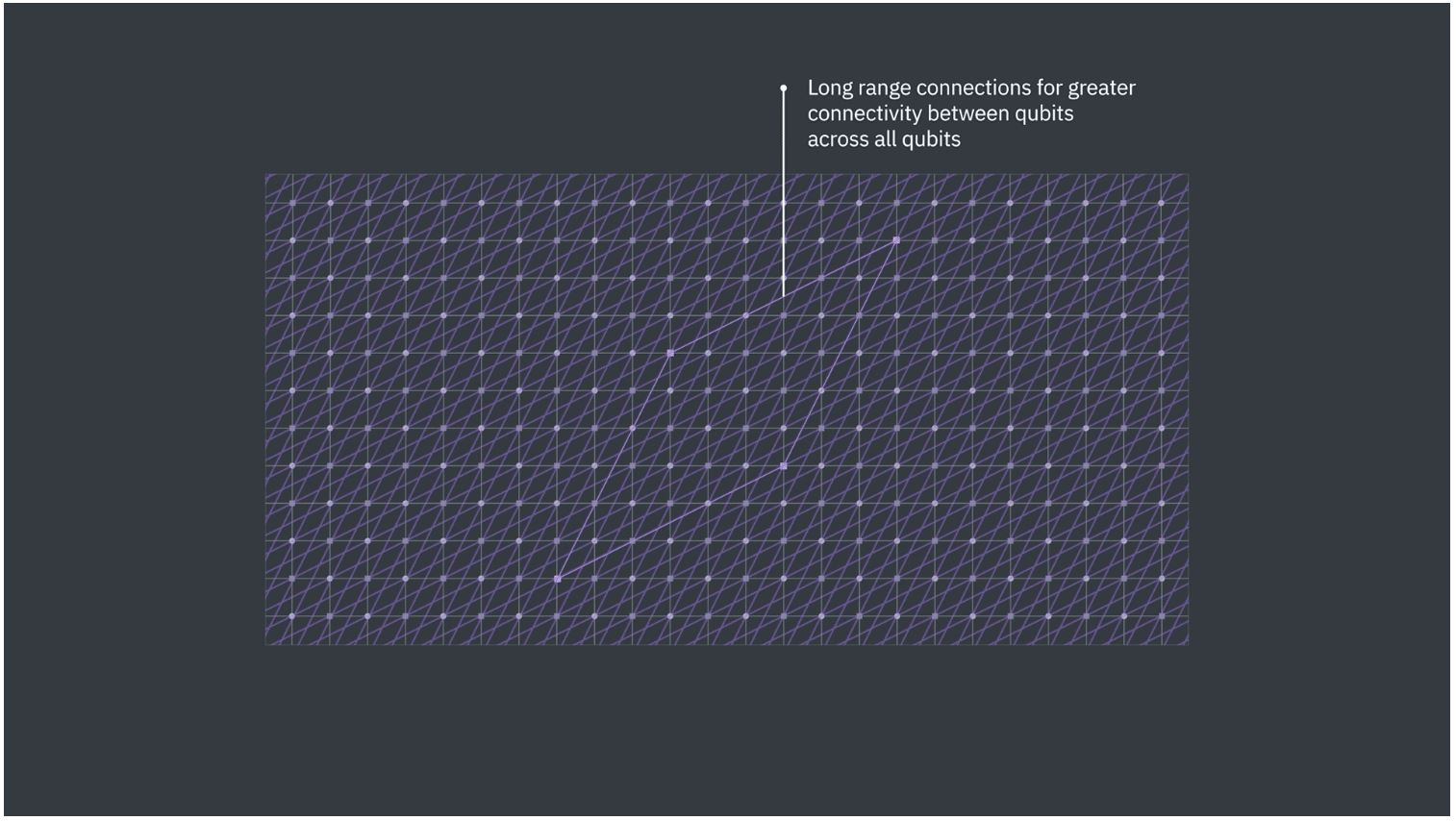
The gross code developed by IBM encodes 12 logical qubits into 144 data qubits, or a 'gross' of data qubits, along with an additional 144 syndrome check qubits. Achieving this on the 2D surface of a quantum chip requires long-range connections between distant qubits within the chip — connections which follow the symmetry of a 3D torus.
Last year, our team and their collaborators discovered that we could build efficient, fault-tolerant logical processing units (LPUs) for qLDPC codes4 , 5. These LPUs are based on a technique called generalized (lattice) surgery6 and have valuable properties: they perform logical measurements using low-weight checks, and do so with very few additional qubits. We can use LPUs together with the symmetries of the qLDPC code to perform logical stabilizer computations, such as Clifford gates, state preparations, and measurements. In our new paper1, we design efficient LPUs for the gross code and a larger [[288,12,18]] BB code called the two-gross code that corrects more errors. The combined memory and LPU is one type of module in our architecture.
Our team and their collaborators also introduced concepts for universal adapters, which use bridges to interact and move logical quantum information between modules4 , 7. Parts of the adapters can be implemented using the inter-module microwave l-couplers we first demonstrated last year with IBM Quantum Flamingo. Our new paper1 elaborates on the adapter construction and characterizes a baseline inter-module measurement instruction.
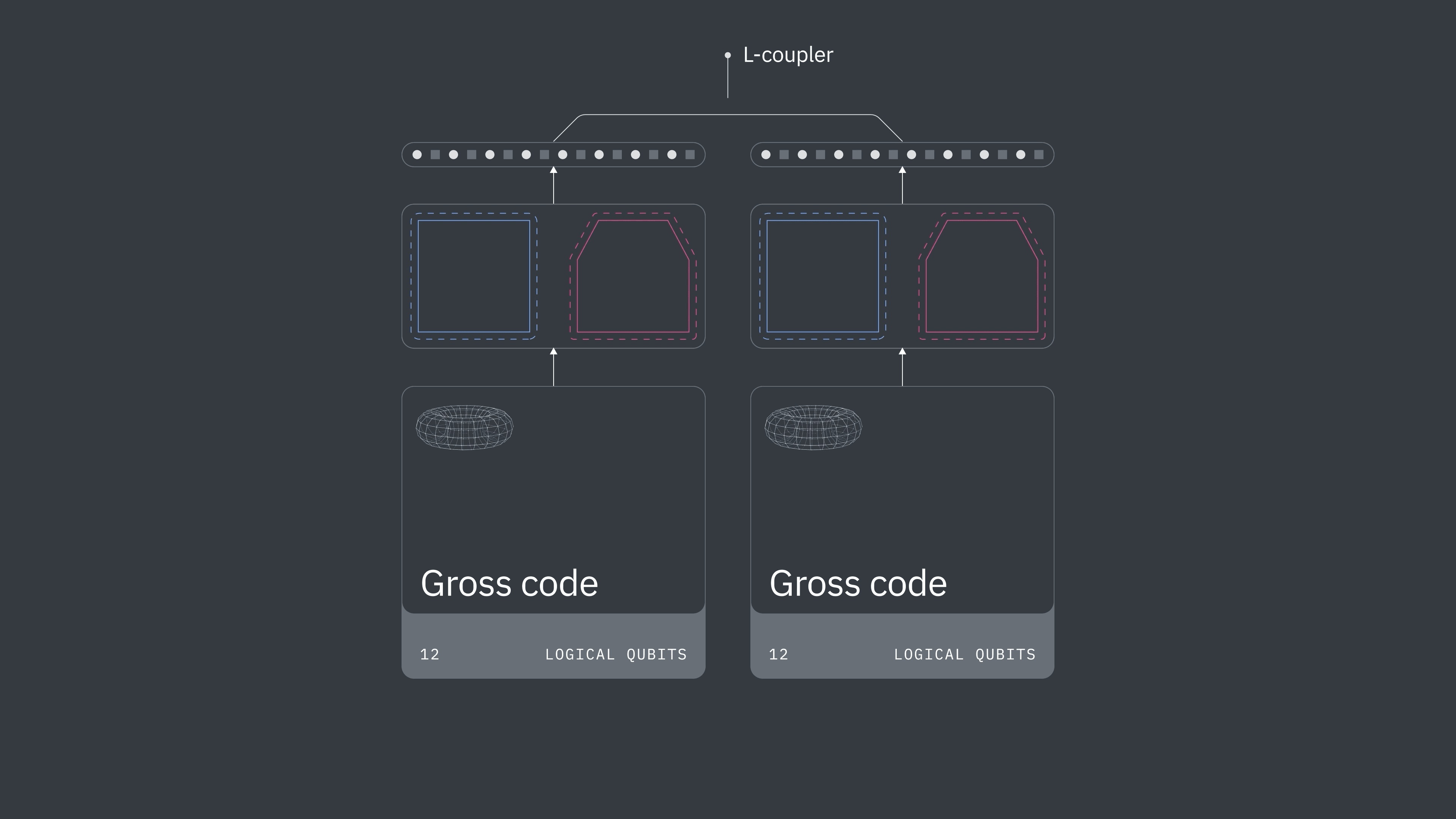
L-couplers enable long-range connections between qubits on separate quantum chips.
Universal computation can be done by augmenting logical stabilizer computations with magic state factories that create, distill, and consume magic states to apply universal gates. Sergey Bravyi and Alexei Kitaev invented the process of magic state distillation in 20048. Our team has made numerous contributions to the development of magic state preparation protocols since then, and in 2024, we published an experimental demonstration9 of such a protocol. Our new paper constructs explicit universal fault-tolerant instruction sets using adapters and magic state factory modules, and presents a compilation strategy adapted to the constraints of the bicycle architecture. This enables all of the operations we need for universal quantum computing.
New paper details a modular fault-tolerant architecture with magic state factory.
The last step is an error correcting decoder, which we will introduce in the Starling proof-of-concept slated for 2028. Alongside our architecture paper, we present the first decoder architecture3 that is accurate, fast, flexible, and compact. It can fit on an FPGA or ASIC, classical components that are ubiquitous today. This decoding technique, called Relay-BP, achieves a 5x-10x reduction over other leading decoders, and shows that we do not need to use large amounts of HPC to perform the decoding required for fault-tolerant quantum computations.
Next time: The IBM roadmap to fault-tolerant quantum computing
 Business users want new applications now. Market and regulatory pressures require faster application updates and delivery into production. Your IBM i developers may be approaching retirement, and you see no sure way to fill their positions with experienced developers. In addition, you may be caught between maintaining your existing applications and the uncertainty of moving to something new.
 IT managers hoping to find new IBM i talent are discovering that the pool of experienced RPG programmers and operators or administrators with intimate knowledge of the operating system and the applications that run on it is small. This begs the question: How will you manage the platform that supports such a big part of your business? This guide offers strategies and software suggestions to help you plan IT staffing and resources and smooth the transition after your AS/400 talent retires. Read on to learn:
LATEST COMMENTS
MC Press Online