








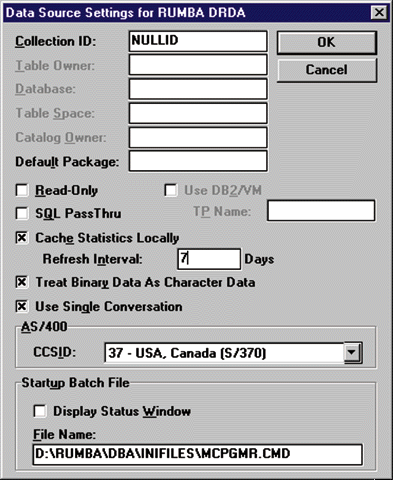
You can significantly speed up your Open Database Connectivity (ODBC) database access if you are using the Wall Data ODBC driver by selecting the option to cache statistics locally. This can be done when you sign on to a data source by clicking on the Options button. Put a check in the Cache Statistics Locally box and specify a number of days for the refresh interval (see 1).
You can significantly speed up your Open Database Connectivity (ODBC) database access if you are using the Wall Data ODBC driver by selecting the option to cache statistics locally. This can be done when you sign on to a data source by clicking on the Options button. Put a check in the Cache Statistics Locally box and specify a number of days for the refresh interval (see Figure 1).
Every time ODBC connects to a data source or reads a file, it gathers information about the data source or file. This can take a long time. Storing the statistics locally will allow the ODBC driver to keep the information on the local PC, reducing the communication overhead and host processing time.
The refresh interval is useful if your database changes. The Wall Data driver will refresh the statistics to be sure the information stored locally correctly reflects the current database layout. The database layout will not change often unless you are doing development work and changing the layout of files frequently. For most production software, the layout shouldn't change unless you upgrade to a new version.
- Brian Singleton
TechTalk: Improve ODBC Performance
Figure 1: ODBC Data Source Settings

MC Press books written by Brian Singleton available now on the MC Press Bookstore.
 |
||
 |
|
i5/OS and Microsoft Office Integration Handbook Harness the power of Microsoft Office while exploiting the iSeries database. List Price $79.95 Now On Sale
|

 Business users want new applications now. Market and regulatory pressures require faster application updates and delivery into production. Your IBM i developers may be approaching retirement, and you see no sure way to fill their positions with experienced developers. In addition, you may be caught between maintaining your existing applications and the uncertainty of moving to something new.
 IT managers hoping to find new IBM i talent are discovering that the pool of experienced RPG programmers and operators or administrators with intimate knowledge of the operating system and the applications that run on it is small. This begs the question: How will you manage the platform that supports such a big part of your business? This guide offers strategies and software suggestions to help you plan IT staffing and resources and smooth the transition after your AS/400 talent retires. Read on to learn:
LATEST COMMENTS
MC Press Online